
On the park
The story of RAF Kings Cliffe, the wartime fighter station that once spread across this ground and far beyond it.
Open days and events
The museum is operated by a small volunteer team. Opening times and events are announced on their Facebook page.
Museum on FacebookPhotograph courtesy of Kings Cliffe Airfield Museum
Beneath the woodland
RAF Kings Cliffe opened in October 1941 as a satellite to RAF Wittering. By the middle of the war it had become an American fighter station, the most northerly and furthest west of them all, and the sound overhead was P-38 Lightnings and, later, P-51 Mustangs.
The runways came up in 1959 and the land went back to farming. The museum keeps the story of the people who flew from here.
A short history
Built as a satellite to RAF Wittering. RAF fighter squadrons fly from here for the next two years.
Kings Cliffe becomes an American fighter station, the most northerly and furthest west of the Eighth Air Force.
Flying P-38 Lightnings, and later P-51 Mustangs, they stay until the end of the war.
His last airfield concert is given in the hangar here, ten weeks before he disappears over the Channel.
The land is sold and returns to agriculture. The runway outlines and the control tower survive.
A volunteer team opens the museum on the old airfield.
Who flew from here
Kings Cliffe was an RAF station first and an American one afterwards. Between 1941 and 1945 it was home to British, Rhodesian, New Zealand and Belgian squadrons, and then to two United States fighter groups — one passing through, one that stayed until long after the war was won.
Royal Air Force · Fighter Command
No. 266 (Rhodesia) Squadron arrived in October 1941, the first of a run of fighter squadrons to work from the new satellite field. No. 616 (South Yorkshire) Squadron followed in early 1942, No. 485 (New Zealand) Squadron in July of that year, and No. 349 (Belgian) Squadron later still. No. 56 Operational Training Unit used the station as well.
What began as a grass overspill for Wittering was rebuilt during 1943 with tarmac runways, concrete dispersal bays and gun emplacements. The RAF presence ended that August.
Republic P-47 Thunderbolt
The first Americans at Kings Cliffe. The 56th came over from Bridgeport, Connecticut in January 1943 with its 61st, 62nd and 63rd Fighter Squadrons, and used the station to work up on the P-47 Thunderbolt. In April it moved on to Horsham St Faith in Norfolk.
P-38 Lightning, then P-51 Mustang
The group that made the station its own. The 20th arrived from California on 26 August 1943 with the 55th, 77th and 79th Fighter Squadrons, and stayed on past VE Day until October 1945. Full group operations began late in December 1943 on the twin-boomed Lockheed P-38 Lightning. The last Lightning combat mission was flown on 21 July 1944, after which the squadrons converted to North American P-51 Mustangs.
Escorting the bomber streams to targets on the continent was the main work. From March 1944 the group flew as fighter-bombers too, strafing and dive-bombing airfields, bridges, vehicles and trains — so many trains that it became known as the Loco Group. It was awarded a Distinguished Unit Citation for its part in attacks on German airfields on 8 April 1944, and flew 312 combat missions in all.
The cost was heavy. In the Lightning period alone, between December 1943 and July 1944, the group lost 84 pilots.
Lest we forget
Kings Cliffe Airfield · Station 367
To commemorate the eternal memory of those American, British, Belgian and Commonwealth airmen who gave their lives in the cause of freedom 1939–1945
Lest we forget
The memorial stands as two tapering stone plinths, each topped with a fighter wing — one a P-51 Mustang, one a Supermarine Spitfire — joined by a tablet of polished black stone. Squadron badges are carved into the wings and into the plinths beneath them: the 55th, 77th and 79th Fighter Squadrons and the 20th Fighter Group, alongside 266 (Rhodesia), 616 (South Yorkshire), 485 (New Zealand) and 349 (Belgian) Squadrons.
It was raised by the Kings Cliffe Airfield Memorial Trust and unveiled on 25 August 1983 by the Duke of Gloucester. Nine people from the village who died in the war are remembered in the village church.
The memorial stands at the roadside beyond the park boundary, not on the park itself. Anyone can go and see it, but there is no route through from the lodges, so it means going round by road rather than walking there.
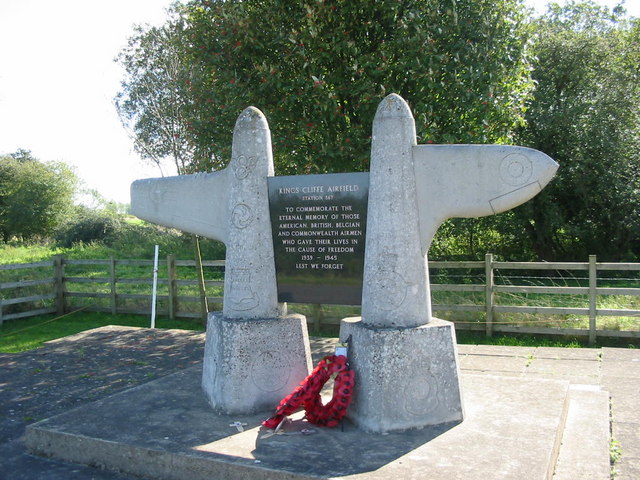
Photograph of the Kings Cliffe Airfield memorial © Mike Bardill / Geograph, licensed under CC BY-SA 2.0.
What is still here
The airfield was kept on for armament storage after the war, then sold and returned to farming in January 1959. The runways came up, but the station has not quite gone. From the air the outlines can still be picked out across the fields, and a good deal of wartime concrete is still standing in the tree lines.
The park stands on one part of the old station, and so does the museum. The airfield was a good deal bigger than the park, and most of it lies beyond our boundary.
All of this survives out on the wider airfield site, beyond the park boundary. None of it stands on park land and there is no route to it from the lodges, so treat this as a list for the curious rather than a walk to plan.
The Glenn Miller memorial is the exception: that one is inside the park, and guests can walk to it from the lodges.
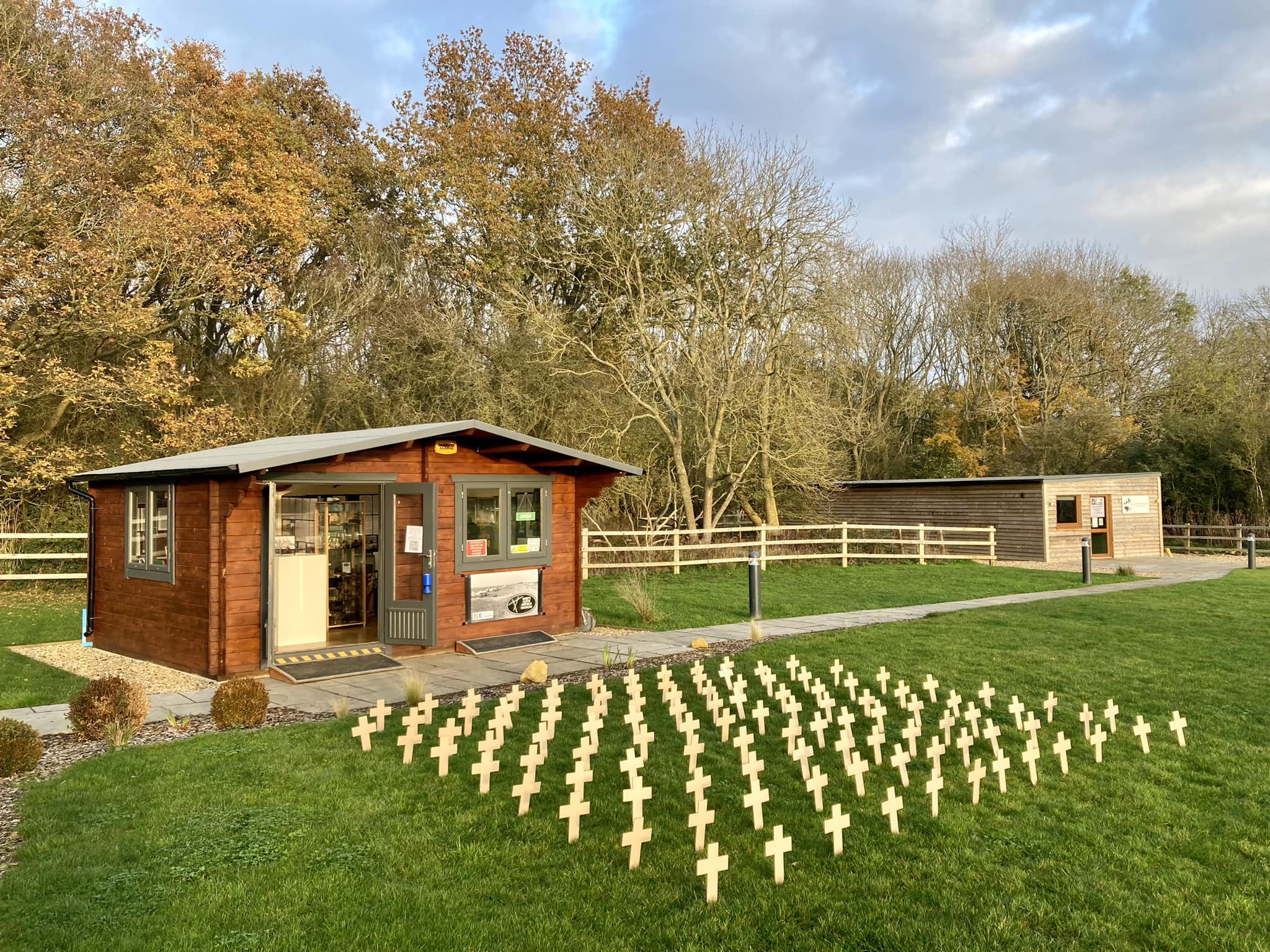
The museum
A timber cabin at Jack’s Green, with rows of remembrance crosses set out on the grass in front of it.